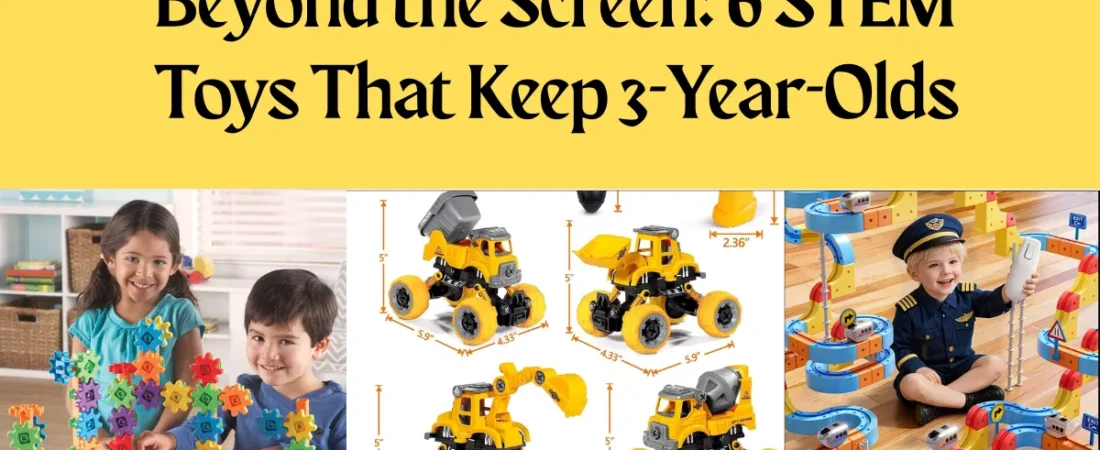
It is a common trap for parents. You buy a toy with hundreds of five-star reviews, only to watch your child play with the cardboard box it came in while the expensive gadget collects dust in the corner. When kids hit age three, their brains undergo a massive shift. They crave cause-and-effect, problem-solving, and building things they can actually interact with. The right STEM (Science, Technology, Engineering, and Math) toys tap into this specific developmental milestone by transforming raw energy into focus and fine motor practice.
Finding toys that balance genuine learning with actual entertainment value is frustrating, especially with thousands of options flooding online marketplaces. We analyzed the top open-ended building kits and interactive playsets designed for toddlers. This guide breaks down six highly engaging, screen-free options that teach spatial reasoning and logic while keeping your three-year-old genuinely occupied.
Car Toys Rescue Playset

This mechanical race track focuses entirely on problem-solving, coordination, and logic. Unlike standard gravity tracks where cars simply roll down a hill, this rescue playset requires active participation. It features a built-in architectural maze with six mechanical buttons, levers, and knobs. Each control operates a specific obstacle on the track, such as a crane, a drawbridge, or a track elevator, forcing your child to figure out which button moves the car to the next segment.
Here is the thing: it requires zero batteries. The entire system operates purely on physics and mechanical linkage, which is a massive plus for parents tired of constant battery swaps. It is best suited for children who love vehicle play but get easily bored by static tracks. The repetitive loop of navigating the rescue vehicles through the obstacles builds patience and fine motor precision.
The practical play value comes from the sheer trial-and-error aspect. Your child learns real-time problem-solving by associating a specific hand movement (turning a dial) with a physical reaction (raising a helicopter platform). However, let’s look at one honest limitation: the included cars are quite small. If your toddler is still prone to putting toys in their mouth, you will need to supervise them closely during play.
Learning Resources Gears 100-Piece Deluxe Building Set

If you want to introduce your child to basic engineering and physics without overcomplicating things, this 100-piece gear set is an excellent entry point. The set comes with pillars, connectors, axles, interlocking base plates, and colorful gears. Kids snap the bases together, stack the pillars, attach the gears, and use a crank handle to set the entire creation into a synchronized, spinning motion.
What this really means is that your kid gets an immediate visual lesson in mechanics. It is suitable for toddlers who enjoy stacking blocks but are ready for something more complex than standard wooden squares. The open-ended nature of the pieces means they can build towering vertical structures or sprawling horizontal networks. The play value scales as they grow; a three-year-old might just enjoy spinning two connected gears, while a five-year-old will attempt to link all 100 pieces into one massive machine.
The build quality is durable, and the pieces snap together securely enough to handle toddler force. The reality of this toy, though, is that the sheer volume of pieces can feel overwhelming at first. Because it is completely open-ended, younger three-year-olds might need you to sit down and help them build the base infrastructure before they understand how to make the gears rotate together.
Matching Letter Game

Moving away from construction, this matching game bridges the gap between physical toys and early literacy. The game setup includes a primary plastic matching tray, a set of double-sided picture cards featuring simple three-letter and four-letter words, and a collection of letter cubes. Children place a card into the slot, look at the illustration, and search for the correct letter cubes to spell out the word.
This toy is built for kids showing early signs of letter recognition or those preparing for preschool. It turns what could be a dry flashcard session into a tactile matching puzzle. The tray features a flip-top flap that can hide the spelled word on the card. This means younger kids can use it for simple letter-matching by looking directly at the word, while older kids can use it as a memory test by hiding the text and spelling from memory based on the picture alone.
The practical play value is high because it targets two developmental milestones at once: object recognition and word formation. It gives children a physical sense of language structure. The limitation here lies in the card material. The flashcards are made of standard cardboard, which can easily bend, crease, or tear if handled roughly by an energetic three-year-old.
Electric Train Set with 3D Embedded Layouts

This 146-piece deluxe electric train set takes standard track building and flips it upside down—literally. The core feature of this set is its gravity-defying, embedded 3D track layout. Instead of the vehicle simply sitting on top of a flat plastic rail, the motorized car securely locks into an embedded channel within the track. This structural design allows the track to curve, climb vertically, and run upside down without the car crashing off the rails.
This set is perfect for highly energetic kids who love building train tracks but get frustrated when a slight bump derails their hard work. Because the car is locked into the track framework, the train keeps moving through loops and steep climbs continuously. The modular pieces are flexible, letting children bend and snap the paths into various custom shapes and loops.
In terms of play value, it introduces basic concepts of kinetic energy, gravity, and structural balance. Kids can see exactly how the motorized vehicle maintains momentum through a vertical loop. The real-world catch with this set is the assembly process. Snapping the 146 track segments together to create a stable, looping 3D structure requires a decent amount of hand strength and alignment, meaning parents will definitely be on building duty.
LUDILO Take Apart Construction Trucks

Many toddlers love taking things apart, usually to the detriment of household items. This construction truck set leans directly into that destructive curiosity by turning it into a construction project. The set comes with four distinct vehicles—including an excavator and a dump truck—along with a child-safe electric toy drill and manual screwdrivers. Every single part of the trucks can be unscrewed and disassembled down to the chassis and wheels.
This toy is specifically designed for kids obsessed with heavy machinery, tools, and figuring out how things are put together. The electric drill operates at a low, safe speed with large, chunky screws that fit perfectly into small hands. It provides an incredible workout for fine motor skills and spatial awareness, as children must align the screws properly to put the trucks back together.
The practical value is massive because it functions as two toys in one: a complex mechanical puzzle during assembly and a set of functional push-rolling trucks once put together. Let’s talk about the main drawback: the set contains dozens of identical plastic screws and small structural parts. If you do not have a dedicated storage bin for this toy, pieces will inevitably vanish into the abyss of your living room couch.
Magnetic Blocks 200PCS Set
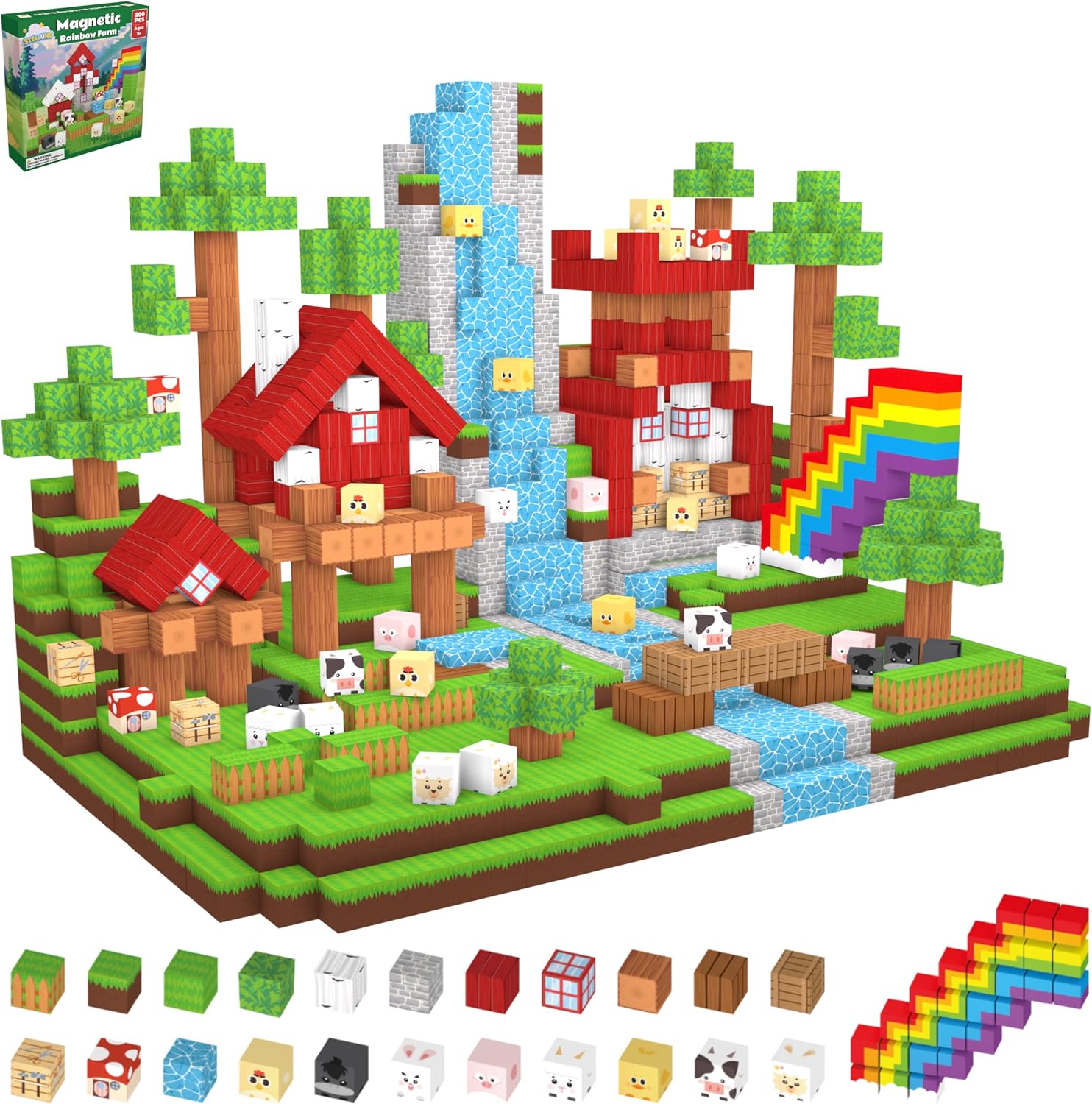
Magnetic tiles have become a staple in modern playrooms, but this 200-piece set adds a creative twist with a rainbow farm theme and three specific light-up pieces. The set consists of solid plastic cubes and geometric shapes embedded with strong magnets along the edges. The blocks snap together effortlessly from any angle, allowing toddlers to build stable 3D buildings, animals, or abstract towers.
This set is an ideal fit for kids who prefer independent, open-ended play. Unlike kits with a rigid manual, magnetic blocks don’t come with instructions on how a child must play. The addition of the light-up pieces adds a fun element to nighttime or dark-room building sessions, illuminating the translucent plastic structures from the inside out.
The play value comes from teaching spatial geometry and architectural stability. A child quickly learns that a wide base holds up a tall tower better than a narrow one. With 200 pieces, there is enough material for massive builds without running out of blocks halfway through. The downside to look out for is that while the internal magnets are secure, the light-up pieces rely on small internal coin batteries that will eventually need replacement.
How We Chose These Toys
We did not just pull these toys from a generic bestseller list. We evaluated each option based on strict criteria that matter to parents:
-
Open-Ended Potential: We prioritized toys that can be used in multiple ways, ensuring they grow with your child over several years rather than being abandoned after one use.
-
Skill Development: Every toy selected targets specific milestones, including fine motor skills, spatial reasoning, language building, or problem-solving.
-
Parent Sanity: We intentionally looked for options that do not rely on loud, repetitive electronic sounds or excessive battery consumption.
-
Physical Value: We assessed how well the toy engages a child independently versus requiring constant adult intervention.
FAQ
Are these STEM toys safe for a three-year-old who still puts things in their mouth? While all these toys are rated for ages three and up, some kits (like the Car Rescue Playset and Take Apart Trucks) contain smaller cars, screws, or blocks. If your child is still frequently mouthing objects, you should supervise play closely or opt for the larger Magnetic Blocks.
Do these toys require constant parental help to assemble? The Magnetic Blocks and Gears set allow for immediate independent play. The Electric Train Set and Take Apart Trucks have a higher learning curve and will likely require parental assistance during the initial setup until your child gets the hang of the mechanics.
How do building toys actually help with brain development? When a child snaps blocks together or aligns a gear, they are practicing spatial awareness, hand-eye coordination, and structural logic. They learn to visualize a concept in their head and manifest it physically.
Can girls play with the vehicle and construction sets? Absolutely. While some marketing titles highlight “boys,” concepts like engineering, mechanics, fine motor development, and spatial logic are entirely gender-neutral and highly beneficial for both boys and girls.
Conclusion
Choosing the right toy comes down to matching your child’s current curiosity with the right physical challenge. Whether they prefer the fast-paced cause-and-effect of the track sets or the quiet focus of building blocks, these options get kids away from screens and into active thinking. Focus on what your child naturally gravitates toward, and let the toy handle the learning.
This post may contain affiliate links. If you buy through these links, we may earn a commission at no extra cost to you.